Thursday, November 1, 2012

This blog returns from the shadows . . .

Wow. It's been that long since I posted to this blog?! Obviously, this blog is becoming officially neglected. Let's see if I can get some sort of reversal going over the winter months.

So, we did the tour in early July. It was brutal: the worst heat in recent memory coincided with our departure and lasted throughout the trip. I was sweating buckets--thank God for Gatorade! I think I went through a few gallons on this trip.

Because of the heat, we cut the tour short, doing only about half the total distance we'd intended to do (only about 300 miles total). I learned some things about electric assist and how it can and can't be used on a longer trip like this. That's not totally germane to the topic of fitness, so I'm not sure whether I will include information about that in this blog.

So obviously, we rode all summer. And we even did a shorter tour in October--only about 200 miles. It was the opposite of the summer tour: freezing at certain junctures (in the 40's and overcast). We did that tour without any electric assist.

Now, we're doing mostly stationary biking indoors--though we did get out and do a few miles today. One of the issues during our October trip was, for me--since I wear cycling sandals--cold toes. I recently got some neoprene toe covers--the kind that you wear on your feet, under your socks. But they don't seem to be as effective as I'd hoped.
On other fronts, we continue our strength training using the JIM routine. We started doing a truncated version last spring after I'd gotten a shoulder injury and continued on that throughout the summer. We anticipate going back to the full version soon and during the winter months.

As a final note, I should mention that I watched a program touting the diet developed by Dr. Joel Fuhrman and decided to incorporate certain aspects of it into my diet. It wasn't very much of an adjustment since I'm a long-time vegetarian. And I don't intend to go "whole hog" with it, since some of it sounds like hype and fad to me. But I see nothing bad resulting from incorporating more fresh and cooked vegetables into my diet and even have some hope that eating more of this type of food might help me to address some long-term health issues.

There. I've officially reconstituted this blog. Now comes the hard part: regular maintenance!

Tuesday, May 29, 2012

Fitness preparation for a bicycle tour

Readers of this blog will know that cycling is the mainstay of my fitness endeavors. I've always enjoyed bicycle riding and the aerobic workout it can provide. And I've especially enjoyed bicycle touring--taking long-distance trips by bicycle--ever since my first cross-country adventure in the early 1980's.

That's not us, but the photo captures well the spirit of bicycle touring
I've previously expressed in this blog the hope that I can continue to do bicycle tours as I age. So far it has worked well for the shorter-range tours we've attempted (less than 600 miles), and I've even begun to structure my annual fitness cycle around preparations for bicycle touring (incidentally we recently got, and are now testing, our new touring rig--more on that in a future entry). So it's high time I wrote some words on fitness preparations for going on a bicycle tour.

I'm certainly not the only one putting out information on this topic. The former long-distance cycling champion Lon Haldeman, who now operates a bicycle touring business, has a page providing tips for establishing a very solid fitness basis for tours his company organizes.

The pactour schedule is a bit extreme and, though it looks like an interesting challenge, I'm not sure it would provide the sort of touring experience I would enjoy. And, for the same reasons, the prescribed physical preparation seems to me too intense: I'm not sure most folks would be able to find enough time to put in the sort of miles they stipulate and, truth be told, why should they try if they're not planning to put in the sort of daily mileage at which pactour aims?

As for myself, our work and other responsibilities dictate that we can get in perhaps 1 - 3 hours of training on a few weekdays. On weekends we have a bit more time, but it's usually between 4 and 7 hours--very rarely affording us a stretch of more than 7 hours for riding. In short, the pactour training prescriptions are not only undesirable, but are unrealistic for us.

That said, we do try to prepare for our tours as best we can. That usually means riding 4 days per week, with two of those days being shorter, more intense rides of 1 to 3 hours, and the other two being longer, less strenuous rides of 4 to 7 hours.

We've established some rules of thumb, that seem to have stood us in pretty good stead thus far, as follows. We first try to determine what will be the longest daily mileage during the course of our tour. Once that's done, we set as our goal to have at least one training day where we meet or exceed that mileage--or, ideally, two days where we put in about that amount of mileage back-to-back. The rest of the time we're taking shorter rides but riding at a more intense pace.

The goal has been to hit that mileage maximum about 2 weeks prior to departure and to decrease mileage in the two weeks immediately prior. So, we'll do our typical 1- 3- hour weekday rides in those days prior to departure and perhaps a 50-mile day or two when we have more time on the weekends (our maximum daily mileage on tours has been on the 70-mile range to date). But it is important to get in some rest and recovery from training prior to the start of the tour.

Before going into further detail on those training principles, I need first to explain why training is necessary at all. After all, can't a person who's reasonably fit just go out and ride 50 miles in a day? And I know that the answer to this question is "yes, he can."

But a further follow-up question ensues: how is said individual going to feel at the end of the ride and, just as importantly, is he going to want to get back on the bike and ride the next day? The answer to those questions gives insight into one of the reasons why training for a bicycle tour is a good idea.

In my experience, I do not feel very good at the end of my first 50-mile day of the year. In fact, I typically feel rather ill. And, though I could get on the bike the next day and perhaps ride another 50 miles, it would be rough going--especially for the first 10 - 20 miles. Now, I tend to ride hard whenever I get on a bike, but I think that even if I were going at a more leisurely pace I would still be pretty sore and not anxious to get back on the bike after that first 50-mile day.

But also in my experience, after taking a few days' break after my first 50-mile ride of the year, the next time I ride 50 miles I feel fine afterward. I will typically feel at least some soreness but can nonetheless easily engage in normal physical activities, both immediately after the ride and the next day. And I could get back on the bike and ride another 50 miles the next day without much bother.

So, one of the major reasons for training prior to a bike tour is so that the early stages of the trip will be more enjoyable. You've acclimated yourself to the distance you'll be riding so you don't collapse in your motel room, unable to do normal and/or necessary activities like going out for a bite to eat at the end of the day. And resuming your trip the next day is not such a chore, either.

Now, there are a number of variables that dictate what sort of training is done in advance of the tour. One of them is the total amount of mileage to be ridden and the amount of time that can be spent. It seems to me perfectly conceivable to, if one has very flexible time limits, do a more limited amount of training than we've been doing for our tours.

If, for example, one intends to ride across the country and has an unlimited amount of time for that, one could spend a month or so taking rather short rides of 20 to 30 miles. Then, at the beginning of their tour they could aim for short jaunts of 20 to 30 miles per day, upping their mileage as they so desire as they travel further. In other words, they would be gaining physical conditioning as part of the trip.

Owing to our rather tight schedules, that sort of training regimen will not work for us. We can only take 1 to 2 weeks for our tours, and we want to get as far away as possible during that interval prior to returning home. So our tours tend to be short and intense (for our age-group, in any case), thus requiring a more intense training period. I would certainly like to have such leisure as to be able to take a more lax approach to training, but for the foreseeable future I'll have to continue with the more intense approach.

But there are other good reasons, aside from making the early part of the tour more enjoyable, to train for a bicycle tour. The main one that comes to my mind is preventing or exposing exercise-induced injuries. What I mean by this is that when miles start to build up and as physical exertion increases, injuries can develop. I think back, for example, on an incidence I encountered while on one of my cross-country tours.

While somewhere in the state of Oregon, if memory serves, I ran across a couple of guys riding together--one of whom was on a touring bicycle and the other on a moped. When I asked them about this odd arrangement I was informed that one of the riders had developed knee issues partway into their tour and had to stop riding. Rather than give up his cross-country touring aspirations, this fellow decided to purchase a moped for himself and to continue riding alongside his buddy.

This is perhaps an instance where a lack of proper training caused issues once the tour was underway: had this fellow done more preparation before starting, the injury either would likely have cropped up during training and could have been addressed then, or it might not have happened at all. In any case, a chronic injury like that developing during the course of a bicycle tour is clearly something to be avoided.

That pretty much summarizes what I have to say for now on the issue of training for bicycle tours. We're still working up to our maximum expected mileage of 85 miles for this trip, and we hope to put in consecutive 80-plus mile days some time in mid-June.

Other than that, my shoulder injury has recurred--likely owing to the use of some unfamiliar exercise equipment in a hotel where we stayed. I also got a slight wrist sprain in a bicycle mishap, and that's still healing up. So I've had to cut back a bit on strength training and am currently only doing half of the strength-training routine we're now performing--and that with certain accommodations (sissy push-ups)--twice weekly.

Monday, April 30, 2012

It's here!

The new recumbent tandem trike came--actually last week. Unfortunately it was damaged slightly in shipping and isn't rideable until a key replacement part that's being sent, will arrive. But, of course, we have another bike to ride in the interim.

On that note, we've been doing mostly short rides on the stationary bike this month. After a very warm start, spring turned cool. And rather than ride in temperatures that are a bit chilly for us, we've decided to ride indoors on the stationary bikes. We'll have plenty of opportunity for hard riding outdoors soon, so why push things early in the year?

Conditioning-wise, I'm feeling pretty good. It's a little disconcerting to see that a hard, 10-15 mile ride leaves me feeling a bit sore the next day, but that's an after-effect to be expected this early in the season. On the bike, I feel great.

A little shoulder issue has cropped up recently--I think it's the rotator cuff again. And I'm pretty sure I know the source of it: we were out of town and using some exercise equipment in a motel. I'm pretty sure I aggravated my shoulder issue when using the overhead press machine--which was not very well configured for someone my height.

So I'm taking things a little easy for awhile here during our upper-body strength training. So, things are going pretty normally in our little fitness world.

Friday, March 23, 2012

Who was that buff, mystery senior?

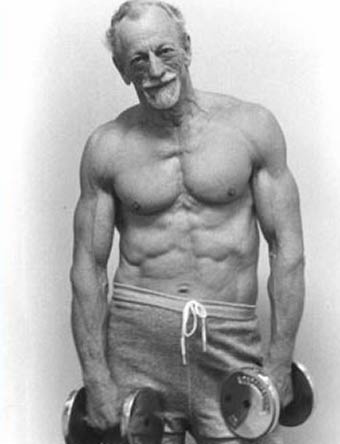
I posted an image I found awhile back of an older guy who has a pretty incredible build. I had no idea who the fellow was, and was unsure even whether the photo was a Photoshop production or an unretouched photo. Well, recently, I found some further information on this fellow and on the source for the photo.

The fellow's name is (was? I think he might be deceased now) John Turner, and in the photo I posted, he is said to be 67 years old. The face certainly fits that age group. John Turner is one of the seniors written about in the book "Growing Old Is Not for Sissies" by Etta Clark (see excerpts from from that book at google books here).

I do not have that book and have never read it, but from what I can gather by looking on google books, the picture I posted of John Turner appears on the back cover. John Turner was apparently a psychiatrist who lived in California and who devoted a fair amount of attention to fitness.

And he apparently did not discontinue his fitness pursuits after that photo was taken (in 1985, I believe). I managed to find another photo of him at age 79. He's definitely not in the sort of shape he was at the tender young age of 67, but he looks about as good as a guy can at age 79. For reference, I'll post the two photos side by side below (no, he didn't really get that much smaller with age :):

John Turner at age 67
John Turner at age79

On that note, we old-timers are still at it. We've managed to get in a few road days on the bike with the unseasonably warm weather--short rides of not more than about 15 miles, but it's too early in the season to worry about going much further. We'll break into the longer days gradually.

I felt I'd lost quite a bit of conditioning over the winter, despite our regular, if limited, stationary bike riding. But after the second day, I felt good and strong. So I didn't lose much.

We're off to do one of our twice-weekly JIM sessions soon. More later.

Monday, March 12, 2012

Officially on the road

I missed posting last month (again!). We've been at our fitness pursuits, apart from a ca 10-day layoff at the end of Feb./beginning of March. Haven't been doing intervals on the stationary bike this winter but have been meaning to start, as the on-road biking season approaches.

Speaking of which, owing to the unusually warm weather, we had our first on-road days over the weekend. Put in about 25 miles total over 2 days. Pretty lame, but we don't intend to start the season with overly-long days. I got a good workout nonetheless, and even had a bit of E.I.A. (exercise induced asthma) afterward.

Tuesday, January 31, 2012

Long overdue update; details about JIM routine

It's high time I stopped neglecting this blog and did some posting. And what better day to start than the last day of the second month during which I've posted nothing? Yes, that was a facetious remark.

Part of the reason I haven't posted is that not a whole lot is happening. I mean that in a good sense. In the context of a fitness blog, the good sense has the meaning that our fitness routine hasn't changed much: we still work out 6 days most weeks, four on the stationary bikes (it's winter where we live) and two days of strength training.

If I could report anything new, it would be in the way of offering further details about our new, JIM (it's an acronym) strength-training routine. The acronym is in honor of the relative who helped me formulate the routine, by the way.

The routine uses some of the same exercises we've been engaging in to date and, like our other strength-training routines, is focused on the upper body. The way it differs is mainly in its simplicity: we're doing only five exercises (we'll add a sixth later), most of which are body-weight exercises. And we do five sets of each. The whole routine takes about a half hour.

The six exercises, in the order in which we execute them, are: 1. inverted rows; 2. bent-over rows; 3. push-ups; 4. dips; 5. overhead press. Sometime soon we'll add: 6. pull-ups. The first two sets are warm-ups, where we do less repetitions or use light weight. The last three sets are to be done with more weight and at maximum repetitions.

So far it's gone well. I like the variation it's introduced. We've also varied our--what I'll call "mid-section" exercises. Instead of doing what are typically called abdominal exercises, we're now doing what might be better labeled "core exercises." I'll post more detail about them later.

There, at long last, is the update I've needed for some time now to post here.

Wednesday, November 30, 2011

Cheap shot

Ok, this post is a cheap shot. Its only real purpose is to alleviate my conscience. It does that by offering me the comfort of knowing that the month of November did not really go by without me posting a single entry here. Is that lame, or what?

Oh well. We're taking a break from fitness at the moment--10 days worth. Cycling now is pretty much limited to short sessions on the stationary bikes. But we have inaugurated a new upper-body strength-training routine, one we developed with the help of a relative who has some experience in this area.

I call the routine "JIM," in honor of my relative, and will be posting more about it soon.

Thursday, October 6, 2011

Back from the short tour

We got back from our short, independent (independent insofar as we did not join any group, but planned and rode the whole thing by ourselves) fall tour. We hit some really brutal hills in certain spots, which provided as much of a workout as an old body like this can handle: those were some serious intervals. Averaged about 50-55 miles a day. So we got in some good exercise and probably our last long mileage of the year--probably around 250 miles total over 5 days.

Kinda sad to call it quits for the year, but we had more than our share of mechanical issues during this trip. That made us a little less reluctant to end this one.

Thinking now of getting a different bike for touring--a recumbent tandem trike (something along the lines of what's in the photo above). They're pretty pricey, but it seems like having such a machine would resolve several issues we've faced.

Back to strength training tomorrow.

Tuesday, September 20, 2011

An uninformed assessment of CrossFit

CrossFit, a fairly popular fitness regimen, came up in a discussion with a relative the other day and I thought it would provide a good opportunity for a blog entry. The relative mentioned that he did not approve of CrossFit as a fitness regimen, which got me thinking about why I have not used it.

I should point out to begin with that I call this assessment "uninformed" because I have never tried CrossFit: my only exposure to it thus far has been through reading about it or about the exploits of those who have tried or are using it. Furthermore, I have no formal training in the fitness field and, as merely a casual fitness practitioner, am far from being in a position to offer anything approaching an authoritative appraisal of CrossFit--even if at a distance. I nonetheless do hold that I have perfectly valid reasons for not using it, though those reasons are quite unique to me and my own philosophy and situation. Your mileage may vary. Thus, the following.

I learned about CrossFit some years ago, when I was initially planning out my current fitness regime. Though it had some attractive features--namely the fact that the regime makes use of both calisthenics and weights--I quickly ruled it out as viable option for me.

One of the main reasons I decided against using it was because it incorporates lower-body exercises--not a bad thing in and of itself, of course, just bad for me because, as I've written previously, I get all the lower-body exercise I need and want from bicycling. Taking on other lower-body exercises would be apt to interfere with my cycling endeavors, and is therefore something I do not want or intend to do.

And, as I am not looking for lower-body exercises other than cycling, I am also not looking for other forms of aerobic activity than cycling. So, the aerobic activities that the CrossFit program entails were also something that holds no interest for me: I get all the aerobic conditioning I need and want from bicycling.

Another major reason I did not opt to get involved in this form of fitness is convenience: there is no CrossFit affiliate anywhere near where I live, so in order to participate in a group setting, I would have to drive (or perhaps bike?) some distance, and in my pragmatic considerations, having to drive anywhere in order to participate in fitness activities is a non sequitur: if one were to walk, run, cycle, or use some other means of self-propulsion to get there, wouldn't that serve as the only activity needed to attain fitness? Perhaps if there were an affiliate within a short walking distance I would have tried CrossFit. But barring that scenario it is simply quite impracticable for me.

And my reasons for not undertaking CrossFit on my own as opposed to at an affiliate, are also pragmatic: I could only see myself doing CrossFit at an affiliate because I do not own, nor do I wish to invest in, the equipment required to execute the routines. I don't have an olympic weight set and certainly don't want to purchase and store one, and I don't see how a number of the exercises they prescribe (squats, deadlifts) could be done without one. So Crossfit was ruled out for me on those scores as well.

Finally, I should point out that CrossFit seems to be a community-centered fitness regimen. In other words, it cultivates and seems heavily reliant on, a community of exercise enthusiasts who urge along one another. Now I certainly don't intend to demean communal fitness programs: I can see many advantages to having exercise partners and a social context for fitness endeavors. But for me this is not needed. I have an exercise partner and to date, we have been all we both need for inspiration to continue exercising. I certainly can't fault anyone who does not have a good exercise partner from seeking out one or more, but for me it is simply not needed. So, CrossFit loses on that score for my purposes as well.

This is a concise synopsis of my own rationale for foregoing the CrossFit regimen. These things having been said, I can certainly see some virtues in the program. First and foremost among these is undoubtedly the comradery aspect of the program: having a fitness partner or partners can be a huge incentive to, if not beginning an exercise regimen, certainly to sustaining one. The incorporation of body-weight exercises and more calisthenic-oriented ones such as rowing, as well as the wide selection of exercises they prescribe, seems also a big plus in my view (variation) even though, as I said, the lower-body exercises are a detraction for me.

None of the reasons I list as obstacles to involvement in CrossFit are likely to apply as they do in my circumstance to the situations of others. So this review, while spelling out what I consider to be valid and substantial reasons for not getting involved in CrossFit, will not likely serve as a deterrent for many who are considering taking up this regimen. But it may, at the least, provide some food for thought for those casting about for a fitness regimen and may thus, ultimately, be of service to someone. And this is, in part, why I offer my thoughts on the matter.

There you have my uninformed assessment of CrossFit.

Monday, September 12, 2011

Bike tour aftermath

In an attempt to rein in procrastination, I need to get this entry out of the way. It's been way too long since I posted anything here, yet things keep coming up that I want to write about and I keep not writing. So, here's to overcoming writer's block and procrastination.

The tour ended some time ago and it was a joy for us. Well, if you subtract getting rained on then cold afterward, two flat tires, searing heat, harsh headwinds, etc. But despite those things it was a joy. Why? Because part of the reward from bicycle touring is overcoming hardships and getting to your destination despite obstacles. But more on that later.

We did over 500 miles in about 10 days. And at the end of it, we were sad that we had to stop.

Well, we didn't actually stop altogether. We, of course, continue riding. We're in training now, in fact, for another, shorter, tour--just 5 days this time.

And the tour had its health benefits. My blood pressure after we got back was almost ideal: I saw 119 over 72 a couple of days after we finished. That's without any medicine. But it's since then gone up a bit.

I want more . . .

We continue our upper-body strength training--we're still in the arm toner phase. I did have to leave town for 10 days, so we took one of our breaks from fitness during that interval, not doing any cycling or strength training. And we're fine with that.

So there. I've broken the procrastination cycle and hopefully preempted writer's block.

Sunday, July 17, 2011

Preparations for the upcoming bike tour

That's the headline for at least the last month. We've been training for our upcoming tour, which starts toward the end of the month.

We put in just short of 200 miles a couple of weekends ago. That was the culmination of our training. We're now tapering off to get ourselves rested up prior to the start.

So we've put in lots of miles these weeks. We've been riding in the heat so as to try and acclimatize ourselves to conditions we may be facing while on the road. And we'll still be putting in miles in the coming days, though shorter ones.

We've slacked off a bit here and there on our upper-body strength training. For example we missed doing our last session. And prior to that we did some half sessions, i.e., we did only part of the arm toner routine we're using at this point in the year.

But that happens. Sometimes the session has to get shortened or canceled. In this case, we're cutting back a bit on upper-body work so as to focus more on cycling. But in the fall/winter months it ends up that our hardest workouts are usually the upper-body sessions, while cycling (stationary bikes) is less intense.

This is our fitness philosophy. Sometimes you miss workout sessions, and that's ok. Sometimes one form of fitness overshadows another, and that's ok too. Flexibility in our fitness pursuits is what we're after.

Wednesday, June 22, 2011

It's time to celebrate!


Ok, there's a bit of hyperbole in the title of today's entry. You see, nothing particularly eventful happened today. Or yesterday. Or the day before. Or, probably, tomorrow or the next day. So, what's to celebrate about?

Well, it occurred to me the other day as I was thinking about what I'm doing fitness-wise and how long it would last. Won't I get bored with it at some point, won't it become a burden? Will I give up this regular fitness regime and go back to an active, as opposed to a very active, lifestyle? I hope not. I've sustained this regime for some time now, and I'm trying to organize things such that it can be sustained indefinitely--as long as I'm still alive and physically capable.

And that's what got me thinking about celebrating. I should be celebrating, I thought to myself, the fact that I've sustained my current regular fitness regime for over 3 years now. It's an accomplishment, and one I should not be taking lightly. Perhaps I could think of today as my 39th (month) anniversary of staying on a regular, year-round exercise regimen. Hooray for me! Keep up the good work!

On other fronts, I'm experimenting with electric assist for my bike--this in the hope that it will facilitate some long-distance bicycle touring such as I did in my younger years. "What!?" you may say, "you're talking electric wheels on a fitness site?!" All I can say in response now is that I'll have more to say about that in a subsequent entry and that, yes, I will address how it has/will impact my fitness endeavors--not a whole lot, as you will see.

And I continue looking out for new fitness routines to augment our upper-body strength training regimen. Nothing major to report on that front at the moment, but when something newsworthy develops I'll post about it here.

Wednesday, June 8, 2011

Further thoughts on workout variation

I ran across an article on yahoo yesterday entitled "The 5 Biggest Exercise Myths" that gave me some further ideas about workout variation. I just want to make a sort of mental note about the substance of the article here. But before doing that, a bit of review on the need for variation in workouts as well as an update on how my current experiment with variation is going. Oh, and, incidentally, the article can be found here.

So, why variation in workouts? As I've observed previously, it's to offset monotony. Sort of a mental trick to counteract some of the trudgery that can go along with engaging in fitness regularly. The theory is, keep things changing in order to sustain interest and perhaps to help boost morale. Sounds simple enough, doesn't it?

My own approach to varying things centered first and foremost on finding a few "canned routines." In layman's parlance this means finding a few exercise DVD's that suit my needs (upper-body strength training) that I can follow along with.

Well, we're in about our third year of working with those DVD's. So, though we've got some basic variety, I'm now looking into ways to vary things yet a bit more.

I recently decided that, for most of any given "phase" of our fitness cycle, I should be varying things by working out at a lower intensity. There should be a few sessions in each phase when I really go all out, but most sessions should be done at a lower intensity. I'm experimenting with that now.

And it's going ok. I can say it's refreshing to not have to feel that I'm pushing to my maximum all the time. It has its challenges but so far seems to be giving the desired effect.

One thing I will note here though is that I was initially thinking of doing high-intensity sessions toward the end of a given phase, while lately I've decided it's probably better to do the high intensity sessions at the beginning. But I may further change things based on what's said in the article I referenced at the beginning of this entry.

Before I address that issue though, I need to provide an overview of the article. Thus the following. It's a short piece that challenges some fitness "myths." What this means in the main is that it questions numerical standards such as the 10-repetition, 3-set formulas. Its not very technical and the alternate suggestions they make do seem appealing to me.

For example, the following excerpt:

MYTH #1: DO 8 TO 12 REPETITIONS
The claim: It's the
optimal repetition range for building muscle.

The origin: In 1954,
Ian MacQueen, M.D., an English surgeon and competitive bodybuilder, published a scientific paper in which he recommended a moderately high number of repetitions for muscle growth.

The truth: This approach places muscles under a medium amount of tension for a medium amount of time—it's basically The Neither Here Nor There Workout.

Here's the deal: Higher tension—a.k.a. heavier weights—induces the type of muscle growth in which the muscle fibers grow larger, leading to the best gains in strength; longer tension time, on the other hand, boosts muscle size by increasing the energy-producing structures around the fibers, improving muscular endurance. The classic prescription of 8 to 12 repetitions strikes a balance between the two. But by using that scheme all the time, you miss out on the greater tension levels that come with heavier weights and fewer repetitions, and the longer tension time achieved with lighter weights and higher repetitions.

The new standard:
Vary your repetition range—adjusting the weights accordingly—so that you stimulate every type of muscle growth. Try this method for a month, performing three full-body sessions a week: Do five repetitions per set in your first workout, 10 reps per set in your second workout, and 15 per set in your third workout.


That gets the variation gears working yet further in my mind. I don't intend to do 3 workouts per week, but it does seem as though I can adapt these directives in some way into my strength-training routines.

I could, for example, try to use heavier weights and fewer repetitions--and possibly more sets--during certain workouts. It doesn't seem, as I think of it now, that this is something I need to plan into my annual fitness schedule, but more like something that could be introduced more or less spontaneously. But I am still considering what are the possibilities for my purposes.

I should mention in closing that the article is tackling what could be considered body-building myths. In other words, they're saying that the received wisdom among body-builders is not necessarily going to build muscles as large or as quickly as has been assumed.

Which makes what's being said somewhat irrelevant to me, since I'm not trying to build bigger muscles. That said, the workout variation potential the article offers is definitely interesting. So I figure following some of the advice they give--despite the fact that I in no way, shape, or form, am interested in body-building-- certainly can't hurt me. It can help me introduce some further variation into my regimen and, though I don't vehemently opposing increasing the size of my muscles, I can't say that, if they did grow a bit further, I'd be terribly disappointed.

So, it's got me thinking. I'll be posting again on this topic once I decide how I can actually use the information I've found.

Sunday, May 29, 2011

About my diet

I haven't posted much of anything here about my diet thus far. The details of my eating habits are not, I think, crucial to understanding my own health or even the more general topic of this blog, i.e., health and fitness at age 50 and beyond.

Still, in the interest of full disclosure, I feel I should offer a few comments about my diet. Thus, the following.

I have been what might be most concisely termed an ovo-lacto-pesco vegetarian for many years--going on 25 now, actually. So in many respects I've been for the most part observing a pretty healthy diet for quite some time.

In case it's not apparent from the terms I've used to describe the diet concisely, what they mean is that I do not eat red meats and poultry, though I do incorporate other animal products into my diet--namely eggs (the ovo part), milk and dairy (the lacto part) and fish (the pesco part). I must observe that lately, in an attempt to address some digestive issues, I've cut way back on the dairy part of the diet, so I'm presently eating very little in the way of lactose.

My diet does vary during the year to some extent, there having been periods when I've followed more what might be called a vegan diet, i.e., one with virtually no animal products. But I have, with advancing age, been trying to vary the diet less and less and trying to and eat more of the same types of things throughout the year

I did not actually adopt this diet for any kind of health reasons--though I do think it has had much to do with my steady weight over the years. Probably it has played a key role in the pretty low cholesterol readings I've had as well. But that was no my intention when I started eating the way I do.

No, I actually eat this way for religious reasons. I led a fairly intense religious life for some years, and in the setting where I did that, an ovo-lacto-pesco vegetarian diet was what we followed. Though I left that life quite a few years ago, I continued following the eating prescriptions even down to today.

I have to say that I really do not recall missing red meat in my diet. Perhaps toward the beginning I had an occasional craving for red meat--I just don't remember. But I can say with confidence now that I don't feel any sort of craving for meat. I have tried a bit of meat here and there during the last quarter century, just to see what it tastes like again. But I've had no desire in those instances to go back to eating it.

That said, I am a fairly ruthless pragmatist. So, if I decided that red meat would be a good thing to have in my diet, I'd have no qualms about eating it. But so far--low-carb and paleo diet trends notwithstanding--I just haven't seen any compelling reason to go back to it. But I am keeping an open mind, and if I thought a change in diet would address some of my chronic health problems, I'd definitely be amenable to some experimentation.

That said, I wonder as I write this what my health and physique might be like now had I not given up eating red meat all those years ago? Hard to say. But I do feel like I must assign some degree of credit, given what I believe to be my unusually trim and athletic build for a man my age, to the dietary rules I've followed for the last two decades and more.

So, there you have it. If this entry will be of help to someone pondering their dietary habits, I'll be happy. If anyone has disagreements to voice or advice to offer, please feel free.

Wednesday, May 18, 2011

A new evolution in our fitness regime: using lists

This is sort of another ho-hum contribution. But I want to write about it anyway in case it may benefit anyone else. It will also help me to remember the stages of progression in our fitness pursuits.

Lists. Yes, I've been hoping for some time now to get away from the DVD's we're using for our strength-training sessions and simply to work from a list of exercises. Why?

Part of the reason for this is that I get tired of watching--and hearing--the same thing over, and over, and over, and over (etc.) again. But I also see it as a small step in progressing beyond canned fitness routines to something I devise myself. We've now made some actual steps in that direction.

For now, I've simply made lists of the exercises, in the order in which they occur, from the DVD's we use. Not too creative, but it's a first step. So, rather than popping in, for example, the Arm Toner DVD when doing our strength training during the Arm Toner phase, we just consult a list of the exercises done on the DVD as we go through the routine.

There are a few reasons--aside from the fact that I think it will help us to progress in our fitness undertakings--this has turned out to be a good approach. One is that we can play our own music while exercising. That's a relief after listening over and over again to what's being said on the DVD's (and we even get in a little extra exercise by dancing during "stretch breaks" :) ).

But, as I said, the main reason we're doing things this way now is to try and progress closer to a point when we can, by picking and choosing from exercises we've done, design our own routines. Once we're able to do that, we will likely have minimized the drudgery that usually accompanies regular fitness pursuits--also called, not surprisingly, "routines."

We'll undoubtedly still pop in, and work out along with , a DVD from time to time. That will help us to ensure we're using proper form. But I assume we may also notice nuances in the routines that had escaped our notice with repeated viewing.

In any case, I'll be offering updates on how things are going with our new approach involving lists. Stay tuned for those.

Friday, May 13, 2011

The challenge of low-intensity workouts

The title probably sounds a bit self-contradictory. But it's accurate--at least in my experience so far.

What do I mean? Well, this entry is a follow-up to my last entry, where I discussed a new experiment I'm trying--one in which I'll be doing most upper-body strength training sessions within a given phase at a low intensity, while doing just a few sessions at the end of the phase at full intensity. I'm hoping thereby, as I said, to introduce some further variation into my workouts.

Ok, so I'm going easy in these last few sessions. What's the challenge in that? Well, I've found it challenging to restrain myself from ramping up the intensity. I start doing reps with the resistance bands and think to myself unconsciously, "this is too easy, I'll have to use less slack next time." As you may have noted from my last entry, that's the first step toward getting into competition with myself--something I'm trying to avoid during this low-intensity segment of the experiment I'm doing during this phase.

So, it takes some conscious effort to ramp down the intensity. It's something I'll probably have to work on continuously.

And it brings up some interesting possibilities. I'm perhaps more engaged in the routines mentally than when I'm just trying to go all out in my efforts. So, what will be the effect--if any--on my efforts when I come to the high-intensity segment of this phase?

Might I be able to break through some barriers that I've confronted thus far while being in full-throttle-mode for most workouts? Might I, for example, be able to do more push-ups than the maximum I've been kind of stuck at for a year or two? Do more reps with a given amount of weight?

I'll have to wait to find out the answers to those questions. And, interesting as those answers will be, I can't say that an answer in the positive is terribly important. As I said, I do this for health reasons, not to win any sort of competition or anything.

But still, it will be interesting to see what are the effects on performance. I am--in addition to trying to maintain god health--out to learn, after all.

I'll be posting results as they become available.

Sunday, May 8, 2011

Dullard's revelation: does variation in workout intensity = fitness variety?

It's an enigmatic title, I admit. But I don't think it'll take you long to figure out what I had in mind in formulating it. So please, read on.

I'm slowly coming to grips with the fact that my existence has been a series of moments of intellectual density interspersed with occasional flashes of brilliance. That's a change from, say, 30 years ago, when I might have thought the reverse--viz., a succession of brilliant moments disrupted by occasional bouts of density. And, yes, it's taken me that long to realize the truth of the matter. But I digress.

In this entry I just want to write about a "revelation" I had the other day for introducing further variation into my exercise regimen. And, as I consider how to write about it, I realize that it's something that should have become evident to me some time ago.

Put simply, I've finally figured out that a good way to further vary my regimen is to introduce periods of lessened intensity with periods of heightened intensity. Same exercises, but a slightly different approach. And, as I write these lines, it further occurs to me that we already do this with the staple part of our regimen--the cycling part. Guess I just never thought about it in this way before.

Now, bear in mind that, as I've written previously, I believe that variation in the fitness routine can help us maintain our regimens by breaking up the monotony of doing the same exercises over and over, week after week, and--hopefully--year after year.

What I mean when I mention the role lessened intensity has played in our cycling regimen is that, as readers of this blog (yes, all 0 of you) will be aware, we ride stationary bikes during the part of the year when on-road cycling is not possible. And that we take it a lot easier when doing that than when we ride on the roads. So we have a period of lessened intensity built into the mainstay of our fitness regimen, one that corresponds to cycling season.

Ta daaah!
And, of course, there have been times when I've taken it easy when doing the upper-body, strength-training component of our regimen--mostly on days when I'm not feeling too well--as well. But I never thought of doing something similar to what we do with respect to cycling when it comes to our strength-training routines, i.e., having periods when we work out with less intensity. Nor did I, for some reason, think of that as a way to introduce further variation into our fitness regimen. But now I have.

So, how comes this revelation? Well, there are a few contributing factors.

Perhaps first and foremost is the fact that we're now going into our 4th year of having a regular, year-round exercise regimen. And we've been using some of the same upper-body routines for some time now--some we've done for 3 or 4 cycles already.

And believe me "muscle confusion" has not worked as advertised by the P90X folks (no great surprise to me). That is to say that the exercises, despite the variation we have over the course of the year, cease to have the sort of impact they used to. No longer do I feel sore for days after a hard workout: no, sometimes when I've gone really hard and am expecting the soreness I used to see, I'm pretty well recovered after only 36 hours or so: not much soreness remains at all.

And I find myself "hitting a wall" as well. For example, it's just as hard for me to do 10 push-ups today as it was a year ago. I'm not gaining much in that department--owing, certainly in some measure, to advancing age.

But at the same time I'm not out to win any push-up contests. So, though I wonder about the seeming lack of progress, I can't say it's something that is especially bothersome.

But this sort of thing can, it must be recognized, detract from morale. The seeming lack of progress can make one wonder whether what they're doing is really worthwhile: haven't we all come to that (faulty) conclusion at some point(s) in our fitness journey(s)?

Then, there's a related issue I confront. I tend to get into a sort of contest with myself, always pushing to outdo some previous mark I've made: a larger number of push-ups, more repetitions with a given amount of weight--that sort of thing. That kind of attitude can further erode morale when the hoped-for results are not quickly attained.

But there is really no contest here. I'm deluding myself to some extent in pretending that there is. I'm certainly not going to enter--much less win--any push-up contests. I'd be blown away by just about anyone who's serious about fitness and is even as little 10 years younger than me. So there's a bit of delusion involved in these imagined competitions.

No, the only thing I'm really aiming to achieve in all these fitness pursuits is a good health. So why the contests? No, I think I need to get away from that mentality more. Being intense at times is good, but being in a competitive mode all the time is not and, in my experience of exercising on my own, is even likely to contribute to burn-out.

So, what's needed to counteract that is to deliberately lessen intensity. At least a certain part of the fitness year as I've conceived of it, should be conducted at a lessened intensity. And I plan on that portion being the majority of the year. Yes, intensity in my upper-body strength training is henceforth to be limited to short intervals during the course of the year--as I'm now conceiving of it, to just several sessions of each the phases into which we divide our annual regimen.

And an added benefit to deliberately lessening intensity of upper-body workouts will be to introduce a bit more variation into our regimen. True, we're doing the same exercises. But my speculation is that lessening intensity during most of the period during which we're doing these exercises is going to make them seem somewhat different. And preliminary experimentation proves this out.

Ok, so that's the theory. Now, how will it be implemented?

As I mentioned, I have a habit of getting into competitions with myself, trying always to push harder and outdo myself--often unsuccessfully. So, how can I get myself to "take it easy" for most of each of the phases into which I've divided my fitness year?

My lone experiment thus far was conducted using a resistance band instead of weights. That way, I had only one resistance level--and not a terribly difficult one at that.

It worked pretty well. There were a couple of logistical issues--mainly related to hairy arms and the bands ripping out hairs when performing certain exercises. But I did find using the band to be a fairly effective way of restraining myself.

Another way to introduce restraint would be, of course, to simply set out only lighter-weight dumbbells for use in a given routine. I'm not sure whether I'll use the resistance band or the lighter weights, but either should be equally effective in lessening the intensity of my workouts.

So I would use that band or those lighter weights for most of a given cycle or phase, then, for a certain number of sessions in that cycle, I'd allow myself to push hard--to get intense--to my heart's content. I haven't decided for how many sessions that should go on, nor have I thought much about at what point during the phase those heightened-intensity sessions should occur. Offhand, I presume something like 6 - 8 sessions per phase, and as I've thought about it thus far, those would probably be grouped together at the end of the phase.

But these are matters I'm still considering. Likely I'll have to experiment a bit to see what works best. But that is probably what I'll try to start off with.

So, stay tuned for my reports on how this new form of variation is working and whether, as it seems to me now, it comprises a worthwhile adjustment to my regimen.

Thursday, April 28, 2011

Just another update

So, I've been seriously neglecting my blog lately. My sincere apologies.

Not too much to report. We took one of our scheduled weeks off last week but are back at it this week. We've managed to finally get out and do some riding on the road. Longest day so far is only 24 miles, but we should have plenty more opportunity to increase on that. Upper body strength training is going fine

With this entry I also wanted to post a picture I've seen around. Not sure if it's photo-shopped or not. But I do know someone in his early 60's who has a physique somewhat like this guy's, so it's not a forgone conclusion that this is a photoshop product. The image comes from here--a not too terribly informative blurb on aging and fitness.

As an example, the following blurb from that site:
Here’s the bad news: You lose up to 5% of your strength, flexibility and balance for every decade after age 20. But here’s the good news: With a little effort and determination, you can maintain 90% of the strength, flexibility and balance you had at age 20 well into your 60s, 70s and even 80s.

Sounds hopeful. He's trying to present an optimistic view, obviously. But the math just don't add up. By reckoning using figures he provides, you're down to 90% of your strength, flexibility, and balance by the time you reach age 40. If the pace of loss that he informs us inexorably occurs is correct, then by age 70, regardless of what you do, you're down another 15%--to 75% of what you had at age 20.

This probably comes down to bad writing. Had he thought things out more carefully and been more intent on conveying something meaningful, he probably would have qualified the 5% loss figure with a statement such as "but you can lower that rate of loss by training, the result being that, even into your 60's, 70's and 80's you may be able to retain as much as 90% . . ." I think you get the idea.

More to come, hopefully a bit more regularly now.

Monday, March 28, 2011

Spinning: what to expect

In this entry I just want to reflect a bit further on the spin class we took, hoping that it would provide us with some variation in our off-season stationary bike riding. It turned out to be a bit of a bust for us, so part of this entry will be a rehearsal of reasons we will not be doing further spin classes. But it will also describe some of the features of the workout and so could be helpful for others wondering whether spin class will be suitable to their needs.

The class we took featured a smallish room really packed with stationary bikes. There must have been 30 or more bikes in this ca. 15' by 20' room. So it was pretty tight quarters.

One of my initial concerns--air circulation--was allayed on entering the room. There were a number of wall-mounted fans around the room and the air was circulating well. In my fairly long experience of stationary bike riding I've come to realize that I need a fan blowing directly on me when doing stationary cycling and, owing to the fact that we arrived early, was able to find a spot that suited my needs pretty well.

In the calls we took, most of the bikes face the front of the room, which is where a stationary bike used by the class instructor, and that faces all the other bikes, stands.

Prior to the start of the class the instructor made sure all the fans were powered on, then she put on some loud, high-tempo music. She had a head set and microphone on, which was also plugged into the sound system. As you might guess, it ended up being quite loud in that small room.

The routine started off with some high-RPM, warm-up pedaling. Then the routine itself started.

The instructor was giving directions throughout about at what RPM rate participants should be pedaling, as well as about adjusting tension on the bike's flywheel. At various stages participants were instructed to stand and pedal at lower RPM rates, while at others they were to sit and pedal at higher RPM rates.

With warm-up and cool-down phases, the whole routine took about 40 minutes. This seemed to be the average length for spinning sessions at this particular health club.

There were several things we did not like about this class. To begin with, the noise level was really too much. Were I to do something like this on a regular basis I would definitely be wearing ear plugs. It was just overboard noise-wise.

As to the exercise itself, I found it unsuitable for my needs. The high-RPM seated pedaling was suitable, but the increase of tension on the flywheel, the need to stand on the bike, and especially the explicit instruction to lower the RPM rate to as little as 30 RPM were all extraneous activities for me.

I mean, they make bikes with multiple speeds specifically to allow riders to maintain a certain RPM rate (90 is usually a good rate to shoot for), regardless of terrain. Why would anyone willing go as low as 30 RPM's? Actually, I think I know why: because many of those who do this type of exercise never get on a real bike and ride for any distance. So they are unfamiliar with optimal cadence under real road conditions. The only time many of these people get on a bike of any kind is at the health club.

As for increasing intensity, as readers of this blog will know, I already utilize a means for increasing intensity: it's called intervals. This involves short bursts of intense exercise interspersed with a longer period of leisurely riding. I do these intervals, in large part, to vary my off-season routine a bit. It offers a nice break from high RPM spinning and allows me to shorten the session slightly.

Thursday, March 17, 2011

Just a miscellaneous update

Not much to report. We're remaining injury-free, and keeping at our fitness pursuits. We just finished one of our week-long breaks, but got back to stationary bike riding a couple of days ago. And we've once again started the arm toner phase of our upper-body strength training regimen.

I suppose I could report that we tried a spin class at a local athletic club just to see if it might provide us with some variation in our winter cycling regimen. But it's really not what we want for off-season training--mainly because it's too intense. We'll get enough intensity on the bike once we start riding on the road any time here, and up until we get off the road in November or so. No need for us to, as it were, artificially increase intensity such as they do in spin classes.

We did try about a month's worth of the S90 routine I recently reviewed, just to see how well we could work it into our overall fitness regimen. The results were encouraging. No plans yet as to how/where we'll work it in, but we will undoubtedly be using it for part of the year.

We've mapped out a longer-distance bicycle tour for this summer, part of which will involve riding with the SAGBRAW tour. So we're excited about that. Will be posting more about that in the future.

With the warm weather we're now seeing we're very eager to get back out on the bike.